Eduard Francevič Napravník
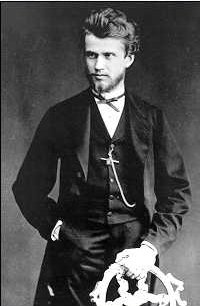
Who could look at a photo of Eduard (pronounced Edward) and not immediately assess that he was definitely some kind of troublemaker? That was my first impression. (The photo here shows the famed conductor in one of his friendlier moments.) His pointed features and intense, beady eyes lent a sinister aura about him in every photo I looked at. When I learned more about the man behind the face, I found my impression to be correct. He was ambitious to a fault, pedantic by nature, and certainly not a man to be trifled with. With these things in mind, I portrayed him (correctly) as one of Tchaikovsky’s talented musician friends but added a certain intimidation factor between them. The shy composer must have been somewhat wary of Eduard, especially in their later years when Napravník had much power as the principal conductor of the Imperial Theatres.
Napravník was a Czech musician from a poor family who was fortunate to attend the Saint Petersburg Musical Conservatory (where he met fellow student Tchaikovsky) and who settled in Russia to continue his career. He rose quickly through the ranks, undoubtedly elevated from his successful performances conducting the young composer’s first operas.
When my readers first encounter Eduard Napravník, he is already at the height of his powers. Tchaikovsky is clearly nervous to be in his presence, and the sinister conductor’s huge ego is laid bare on the page. This was by design of course; I wanted to show him as a nemesis to Tchaikovsky. One may even get the idea that he will play an important role in the illegal trial to come. That could be… but I dare not give anymore away. Suffice it to say that Napravník comes and goes throughout the book and always leaves the reader wanting more. Best regards, Adin Dalton
[NOTE: I thought it might be helpful if I posted in-depth information about some of the main characters in “Fate.” Since these characters are based actual living, breathing people in the 19th-century, scholars do know something about their points of view, attitudes, and general personalities. I had the honor of tweaking these attributes further in my novel of course, and so it will be my take on them that I write about here. I will do many of these over the coming weeks, continuing on from the last one which featured Tchaikovsky’s only sister, Aleksandra. For those readers who flinch every time they come across Russian names, these short characterizations should help introduce them to my characters in a simpler way.]
Discover more from Fate - The Tchaikovsky Novel
Subscribe to get the latest posts sent to your email.
 Fate - The Tchaikovsky Novel