Spring giveaway starts today!

It’s finally April, time for the official Fate / Pyotr Ilyich book giveaway on Amazon.com.   Just click HERE to enter, or share this page (however you like) to give your family and friends a chance to enter as well. There will be multiple instant winners and there’s no catch.  Let’s spread some Tchaikovsky around!  

(If you are reading this notice secondhand and would like to go to the original blog page, just visit www.TchaikovskyNovel.com ) 2018

Sexual scenes in novels

Yes, I am venting a bit today and hope it will be cathartic to get this out of my system… I received another 1-Star rating (and short review) from a new Amazon customer/reader who fully admits that they did not even read the entirety of Fate.  Their problem with it?  “Too much sex.”  I have a feeling that even one short, sexual scene would have been too much for this particular reader, but who knows.  While they are obviously entitled to their opinion, is it wrong for me to wonder why the researching and writing and editing and tremendous soul-searching that goes into the creation of a nearly 700-page novel might at least deserve 2-Stars for the effort alone?  You see my point, right?

In glancing over the 42 posted reviews of my novel, I noticed that many folks have mentioned that the sexual scenes in Fate were enormously “tasteful” and “well-handled,” with one reader even stating that my brief depictions of sex were “nothing that a typical high school student would be unfamiliar with.”  Most modern day novels contain sexual scenes when appropriate to the main characters in the story and should be expected.  Even the best-selling historical novel, Pillars of the Earth by Ken Follett contained raucous sex scenes.  Some are 6 to 7 pages in length and too detailed even for me.  By contrast, my novel contains some sexual encounters that are quite literally three sentences.  The problem may be that my antagonist is also a famous person in history who actually lived.  Some readers may simply not be ready to wrap their heads around a famous historical figure having homosexual encounters.

Now I will admit a few things:  When I penned this story, I knew full well that it would be controversial.  I understood the psychology that occurs when some readers discover famous personages brought to down to flesh-and-bones. I can imagine them thinking,  Tchaikovsky was a genius and is very high in my esteem.  He would never have sex, let alone homosexual sex… he was creating music 24/7 and did nothing else!  (This is, by the way,  how music benefactress Nadezhda von Meck actually thought about Tchaikovsky.)

But perhaps (sadly) the real problem is the homosexuality.  Readers might be a lot more forgiving if the sexual scenes in Fate were heterosexual in nature.  For all the progress made in the last few decades in regard to GLBTQ, there are still many who are offended by it all.  To those readers who have understood the importance of the irrefutable relationship between this composer’s compositions and the simultaneous events of his personal life and liaisons, I thank you.  You will “get it.”  And you will enjoy the read.  By contrast, if you don’t want to know about how Tchaikovsky’s music was influenced by his intimate life then there are many biographies available for you to choose from.  Fate is definitely no “biography!”

The ironic thing is that in reality, Pyotr Ilyich Tchaikovsky was a very naughty boy.  VERY NAUGHTY.  I had to tone him down to a great degree just to make him a bit more likable, and was constantly on edge that my writing wasn’t going to be true to him and to the history.  Now I say, thank God I did tone him down!  I guess it could never be enough for some people though.

Best regards, Adin Dalton

Tchaikovsky’s Manfred Symphony in NYC!

For all my seasoned Tchaikovsky fans, (as well as for those who may just be discovering the genius of his music,) I must announce a special upcoming concert at New York’s famed Carnegie Hall. On March 28th at 8pm, the always-impressive orchestra of the Bayerishe Staatsorchester (Bavarian State Orchestra) will be presenting Tchaikovsky’s Manfred Symphony.  This work is positively dreamy, especially when performed live, and I recommend getting tickets before they’re gone. For those who are familiar with my book’s video trailer may find it interesting to know that the background music used is a section from the Manfred.  As for Carnegie Hall, well there’s no better place to enjoy Tchaikovsky in the U.S.  (Readers of “Fate”  understand why that is!)

The March 28, 2018 performance will be performed on the main stage of the elegant hall and will be conducted by this ‘legendary’ orchestra’s own music director, Kirill Petrenko. Making it even more special, it will be his Carnegie Hall concert debut. Details below; tickets can be purchased on the C.H.  website here

Don’t live in or near NYC? Why not plan a visit?  🙂  All the best,

~Adin Dalton

Performers: 

Bayerisches Staatsorchester, Kirill Petrenko, Music Director and Conductor

Julia Fischer, Violin / Daniel Müller-Schott, Cello

Program: BRAHMS – Double Concerto, & TCHAIKOVSKY – Manfred Symphony, Op. 58

Homosexuality in the old world- more popular than you may have thought

Greetings, January blog visitors.  Happy New Year to everyone!

Readers of Fate, the (only) novel based on Tchaikovsky’s life, know only too well how the composer’s personal relationships, living situation, introverted demeanor, and yes– his music– were all shaped by his strong and exclusively homosexual nature. Some people do not understand why I felt it necessary to include Pyotr’s sexuality in the story at all and to them I say, You’ve missed the entire point. His sexuality is everything.  Not to mention that one cannot separate his sexuality from the specific events leading up to his sudden death at age fifty-three.

It seems the entire subject matter is shocking to many classical music lovers. They have a hard time believing that homosexuality in the “old world” (Russia/Europe) was as rampant as I suggest in the novel. Well, it was. And this is the subject of today’s blog! So fun.

One particular male, gay friend of mine actually thinks that male homosexuality began in the 1970’s.  Or, if it was earlier, it was only the ancient Greeks who practiced it until it reappeared again in the 1970’s. Weird, right?  Other more learned folks who understand that it’s been around forever may not realize just how incredibly popular and practiced it was, especially in nineteenth-century Russia and in the fourteenth to seventeenth-century (Renaissance) Italy.  Special laws against its practice became special laws because it was that rampant.

There was a definite style difference in the practice of homosexuality between the two time periods/countries mentioned above. While men in Renaissance Italy saw it as a forbidden but wildly enjoyable naughty pastime, men in Russia during the 1800’s practiced it quietly with their younger valets and servant boys (if they were of the upper class) or privately with other like-minded men in small clubs and assemblies.  It was almost always an older, dominant male taking pleasure with a younger (and therefore not very masculine) submissive.

During the Renaissance period, the slang term used across most of Europe for someone who was homosexual  was “Fiorentine,” or “Florentine.”  Surprising?  Not when you look into Florence’s sexual history.  The good men of Renaissance Florence practiced their homosexuality with wild abandon, from the private bedchambers of the palazzi to the very streets of the town. The riverside of the Arno was also a popular spot, as was the famous Ponte Vecchio bridge after dark.  It was all illegal of course, as the town leaders tried to control it (or at least be seen as trying to control it.)  In truth it was an epidemic, if I can call it that, and the worst kept secret on the continent. How do we know all this? Well, it turns out that the Florentines of that period were good at something else too: record keeping. And the arrest records, court transcripts, complaints, fines, and alleged accusations citizen by citizen –by name– from that time period have been maintained to this day.  Which brings me to mention an amazing book on the subject.

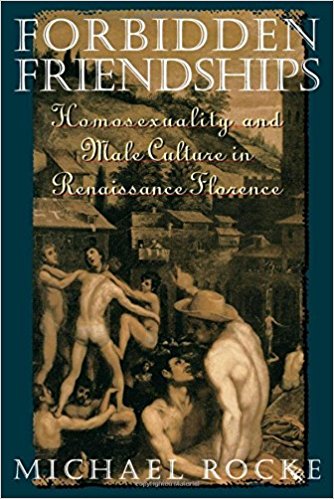
Author/researcher Michael Rocke spent years going over that city’s records and brings Florence’s homosexual past to life through the information he uncovered and organized. His book “Forbidden Friendships- Homosexuality and Male Culture in Renaissance Florence” is nothing short of stunning. Out of print for awhile now, it can be found on Amazon from time time for a price, but worth every penny if you want to have a truly eye-opening experience.  He shares the experiences of real life people and exposes idiosyncrasies of that period in often humorous descriptions of what precisely went on.  During that time for instance, it was so egregious to be caught outside without one’s hat that men wanting a sexual foray with another man could simply grab latter’s hat from his head and tell him that only the act of sodomy will win it back. Nearly all men caught in this blackmail complied; anything to get their hat back on before someone saw them without it!  I hope you look into this wonderful read.

All the best, Adin Dalton

Forbidden Friendships

A unique ballet story for you…

I rarely share my personal stories on this blog but I think this one is worth posting. My entire life was changed when I was eighteen by a video recording of the early nineteenth-century ballet, Giselle. I had no real direction in my life and had no idea what to major in (at UCI) and was just kind of floating through my days like most teenagers in 1978. (You know, no cell phones or internet to fill the time.) The break between two of my classes was just long enough to be annoying but short enough where I couldn’t really go home. In an effort to find something to do, I wandered into the university’s audio-visual center inside the library and looked through a binder of their video offerings. When I saw a listing for some ballet called Giselle, I was curious to see it and told the girl at the counter to play it for me. She had me take a seat in cubicle number 3 where a small television and lone bean bag chair was waiting. All of the low cubicles had televisions and bean bag chairs. As the girl pulled a large reel-to-reel tape (yes, I know, old-fashioned) from the hundreds on the wall behind her, I headed for the cubicle. Before I could even attempt to get comfortable my video started playing. It was a recording of a “Live From Lincoln Center” taped at the Metropolitan Opera House in New York City and touted John Lanchbury as the conductor. I sat back and listened to Adam’s gorgeous overture, more than a little intrigued to see my first full-length, “story” ballet.

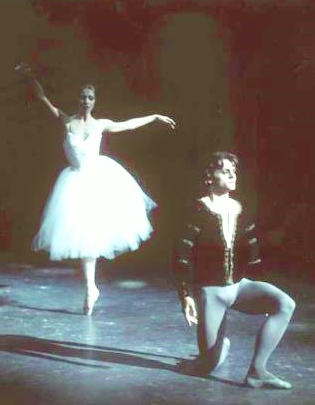
Nothing could have prepared me for what I saw.  The great ballerina Natalia Makarova was Giselle, Mikhail Baryshnikov was Albrecht, and Marianna Tcherkassky danced the Peasant Pas de Deux. Until that moment I had no idea that ballet (or dance of any kind) could be so expressive or tell a story so clearly and sensitively without words. The way Makarova held her arms or titled her head, the way her expressive feet seemed so much a part of the whole of her characterization. And then Baryshnikov’s powerful dancing, the way he took the stage and the manner he interacted with the delicate Giselle was nothing short of amazing. The music too, so perfectly narrative to the events of the story being danced.  It was almost too much for me to take in but I was hooked. I knew I was seeing greatness and needed no one to tell me.  I did not understand all of the details of the story but watched in awe through the mad scene where Giselle finally dies of a broken heart. Tears ran down my face. And when Albrecht reacted to her death so violently, I wept uncontrollably. What had I just seen? Were there more “story” ballets like this? I had to know! I wiped my face and embarrassingly exited the audio-visual center.

For the three months that followed, I spent every one of the breaks between my classes on those bean-bag chairs watching Giselle over and over, always weeping at the end where she dies after the mad scene. I was almost an expert regarding the story but there were details that I desperately needed to understand. I inquired at the library for books on ballet and the librarian wrote the name of a book she thought I should look for at a bookstore. I had watched the Giselle video more than twenty times and was obsessed with it.

At one of the larger bookstores in my neighborhood I found the librarian’s suggestion: Stories of the Great Ballets, by George Balanchine (whoever he was.) It was paperback but seemed chock full of more ballet stories than I ever knew existed.  When I saw Giselle listed in the table of contents I happily paid for it and ran out of the store. There, in my parked Toyota Corolla, I wasted no time in reading the chapter that was going to explain everything I needed to know about Giselle and her world. How amazing it was to read Balanchine’s descriptions…I could visualize the video in my mind as he recounted the details and characters in each scene.  As I read to the end of the paragraph describing the mad scene, I saw that the next page heading was labeled Act II.

Act II?  I said to myself. What Act II?   How could there be another act?  She dies.

I read on breathlessly, in disbelief that I was in love with half a video. Balanchine’s words leapt off the page as I read about Hilarion the hunter in the forest at Giselle’s graveside, and Myrta Queen of the Wilis?  Wili?  What is a wili? I wondered.  I was filled with frustration and could barely wait to get back to the audio-visual center to see the second act . Why had the girl there not told me there was an Act II?

The following day, I confidently stepped up to the the audio-visual counter and asked to view Giselle Act II. (My heart was beating so fast, I can remember the anticipation to this day.)  I was finally going to see all of this masterpiece and I could barely contain myself.  All of life’s mysteries were about to be solved!

“We don’t have it,” the girl said flatly. “Somebody stole it.”  My mind was racing. I had to see it!  How could someone steal a large reel-to-reel tape? What was I to do now?  I felt completely lost. (Let me add at this point how lucky we all are for the invention of the internet where one can buy videos, view You Tube, and easily research synopses and how many acts different ballets have.)

My boyfriend at the time knew all of these particulars and was fully aware of what I was going through. Since we worked at the same place I thought nothing of it when he came walking towards me one day about six months after the events I have described.  He had the Sunday Arts section of the LA Times in his hand and a big grin on his face. He handed it to me and said simply, “Now you can see it.”  I looked down at it and saw a full page advertisement for American Ballet Theatre at the Shrine Auditorium.  There in the ad were the words Giselle.  It was coming to Los Angeles!

We bought tickets in the orchestra and went to see this incredible ballet live.  The performance we chose was danced by Marianna Tcherkassky (now as Giselle) and the great Fernando Bujones as Albrecht.  After the intermission, I quietly prepared myself for the act I had never seen.  I remember being mesmerized by its delicate music, sounding otherworldly at times, and often invoking the love theme used in the first act.  It was so white compared to the first act, a colorless and eerie scene.  I also remember thinking how poetic it was…dance as poetry.  I still think that to this day.  This masterpiece of music, choreography,  and emotion changed me forever and set the path towards my degree in Ballet History.  Giselle remains my favorite ballet and when danced/acted well, still makes me cry.

Today I live on the Upper West Side of New York City, just minutes from Lincoln Center.  I drag anyone I can find to performances of Giselle.  I now own the VHS tape of that fateful “Live From Lincoln Center” performance, and that old paperback of Balanchine’s Stories of the Great Ballets is on a shelf in my library.  I hope that during this Christmas season you will take a loved one to the ballet.  The New York City Ballet is currently presenting its delightful production of The Nutcracker. Yes, everything comes back to Tchaikovsky.

~Adin Dalton

giselle act II

Makarova and Baryshnikov in Act II of Giselle, 1975

How do you get to Carnegie Hall?

…Practice, practice, practice! Or so goes the old joke.  But it’s also a true statement. The high level of music performed at New York’s oldest concert hall is consistently impressive, and fortunately there’s never a shortage of Tchaikovsky on display. Literally on display! Not only do many of the world’s orchestras, artists, and ensembles present works by the Russian master composer, there’s also a wonderful display of archived notes between him and Carnegie, several personal effects and diary entries, as well as other Tchaikovsky memorabilia in their beautiful little museum. It’s well worth your time when you’re in New York.

As readers of my novel Fate know only too well, Tchaikovsky was invited by Andrew Carnegie himself to be one of the conductors on the opening night of the Music Hall (as it was then called.) After all, there were few composers more famous than Pyotr Ilyich– even in America. On that fateful night in 1891, the composer was his typical nervous self and could barely force himself onto the stage. It all turned out well in the end however, and the amazing thing is that his music has never stopped being played there, some 126 years later.

On November 9, 2017 the esteemed Israel Philharmonic will be presenting a true Tchaikovsky jewel, his Violin Concerto. (It’s not numbered because it’s the only one he ever wrote.) And if you’ve never heard it played live, then I urge you to get tickets to this performance. The orchestra will be under the baton of the one and only Zubin Mehta which makes this event at Carnegie Hall one of truly historic proportions.

Happy November!  ~Adin Dalton

Opinion – Orchestral Suite no. 3 in G Major (opus 55)

             As I was cooking dinner the other night, WQXR did me the honor of playing the final movement of Tchaikovsky’s Suite no.3 in G Major. (I always consider it an honor when their channel just happens to grant me a bit of Tchaikovsky when I’m in the kitchen.) Anyway, this final movement is a well-known part of the suite and is called Theme and Variations, or Tema con variazioni, which was actually a popular style of composition structure in the Romantic period of which Tchaikovsky was part.

            The piece features a simple melody followed by variations of it, slightly altered in style, emotion, rhythm, time signature, harmonies, instrumentation, and even key. Tchaikovsky used several of these in combination to shape his initial base melody.

            It is still widely admired today and stands on its own, especially as ballet music. Now, ballet lover that I am, this is not my favorite way of hearing it. For me (and for others I suspect) the dancing is distracting to the brilliance the piece offers. If you have never heard it, I beg you to seek it out. You Tube has many choices if need be. It is nothing short of astounding.

            For optimum enjoyment of Theme and Variations, I listen with headphones, eyes closed so I can fully focus, and let the music consume me. You should try my method too, and see what emotions Tchaikovsky’s twelve variations suggest to you. Below you will find my personal observations of the piece. I believe my impressions are shared by most people because Pyotr Ilyich knew precisely how to invoke a particular emotion in the listener; this was his genius. He cleverly uses phrases of the ominous “Dies Irae” for effect in the fourth variation, and as for the dramatic key change in the final Polonaise…well, it remains as goose-pimply to me today as when I first heard it.  Give it go!

            For readers of my biographical novel, Fate, it may be of interest to note that it was created during one of his stays at his sister’s house in Kamenka and was published by Piotr Jurgenson. It is mentioned in correspondence (written during its creation) to both Modeste Tchaikovsky and Sergei Taneyev.   In my novel, Suite no.3 is only briefly mentioned because its creation and premiere (1885) took place during the passage of time which my story skips over. Ugh, page constraints!

“The [nineteen-minute] finale [Theme and Variations] opens with a rather formal sounding theme for the strings. In the ensuing series of variations on this theme, some of the paraphrases preserve the outlines of the theme faithfully, their altered rhythms, instrumentation and contrapuntal embroidery notwithstanding. Others develop the subject theme’s initial motif in a more free fashion. The final variation leads to a brilliant coda in proud polonaise rhythms.”

Theme and Variations (final movement from Suite no.3 in G Major)

The basic melody can be recognized in each movement even though it has been changed, sometimes drastically.

Introduction of simple two-part melody: Basic, formal, played only by strings

Plucked strings: Very staccato in feeling

Free instrumentation: Frenetic and seemingly uncontrolled

Overlapping woodwinds: Taking the initial melody even further

Heavy cadence: Strong, willful, and ominous

Off beat syncopation of rhythm– Modern and irreverent

On beat emphasis – Power, royalty

Indecorous unison – A holy mass, organ music, joined by a clarinet evoking femininity, gentleness, and forgiveness

Light and fast with syncopation – Childlike, playful, and full of energy

Solo violin interpretation – Exotic and sexy, a single narrative until it is joined by the orchestra

Double-notes: The original melody broken apart and made lilting

Smooth and slow orchestrations – Poignant, heart wrenching phrasing

Polonaise – Fast and lively, the beginning of a spirited dance/ then further varied by rhythm, key signature and key change.   Then, just when you’re sure the entire piece is going to end, it doesn’t. It takes a little turn and builds anticipation all over again to what I feel is one of the best endings of any orchestral work ever. (If it’s conducted correctly, of course!)

Best to all, Adin Dalton

Pyotr & Aleksei

For some reason I’ve been thinking a great deal lately about the connection between Tchaikovsky and his loyal servant, Aleksei Sofronov.  I’m not sure why this is but it has had the effect of reminding me how one of my first thoughts about writing a biographical-fiction of the composer had been to do it completely from Sofronov’s point of view; you know, the ubiquitous Servants’ POV.  As you may know, I decided to go in a different direction. But with the two men so much on my mind I thought it right to share some additional information about them here.  I will try not to spoil anything, in case you’re still reading or intend to read.

It was in Moscow, 1871 that twelve-year old Aleksei Sofronov first had to step in and perform duties as Tchaikovsky’s manservant, replacing his own older brother Mikhail.  Sofronov took over the position permanently in the winter of 1877, setting off what became a relationship of particular closeness, familiarity, and trust between him and the composer. The initial employment was good for the boy, and eventually offered him a steady, paying job that included room and board as well as travel outside of Russia.

The relationship benefited Tchaikovsky as well. He needed and depended on Sofronov’s service, not only for daily errands, grooming, valet duties, and household maintenance, but also as confident. Living together as they did for decades, there were times when Tchaikovsky had no one closer to him (or close-by) as Aleksei Sofronov.  As sensitive and introverted as Tchaikovsky was, he naturally grew much attached to him emotionally and seemed to have felt extraordinary warmth towards him, much of which can be noted in the letters they exchanged whenever they were separated. (Hundreds of these letters have survived, many of which are currently archived at Tchaikovsky’s last house in Klin, Russia, which is a museum trust and welcomes many visitors each year.) In these letters, the composer consistently addresses Sofronov by several different affectionate Russian-style nicknames such as Alyosha -as opposed to Aleksei.

When I had to deal with these two (real people) as characters in my book, their close yet professional friendship was not easy to show in words. I was faced with terrible decisions throughout their changing relationship, decisions that would impact both the emotional force of my story-line as well as the basic narrative. It was important to me from the start that my book present a truthful telling as I saw it, and not just relay the repeated hearsay or innuendo of the past one-hundred fifty years; things unfortunately get twisted a bit over that long a time-span. I grappled with these decisions daily while working to bring their relationship to life, carefully avoiding the extremes in description and dialog that would only serve to create an unrealistic (or even cartoonish) pretense about their obvious bond. To keep their connection to one another realistic, and true to how it probably was, I had to walk a daily tightrope of words and phases. My hope of course is that I somehow succeeded, but I must let others be the judge of that.

-Adin Dalton

Blog note: Today’s posting will seem less cryptic to those who have read the novel Fate.  If you’re interested in the composer Pyotr Ilyich Tchaikovsky and his amazing life, grab a copy today. (Exclusively at Amazon.com)